


Cascade Call for Proposals – VITALITY SPOKE 1 Ecosystem – University of L'Aquila.
CUP E13C22001060006
CDB002467
A pilot plant for smart automation
Nowadays, the need to ensure ever-higher standards of efficiency and quality—with a view to continuous improvement—is driving companies to constantly seek out cutting-edge technological solutions, with investments in highly advanced automation and AI based systems.
This is the case with Tecnomec Sud, which, as the lead partner and thanks to its strategic partnership with LGA Automation, has designed and implemented an advanced system to support its machinery. This project was developed as part of the VITALITY SPOKE 1 Ecosystem promoted by NextGenerationEU under the name “Flexible Smart Dual Bi-Picking System.”
The project, which has been particularly ambitious from the outset, aims to achieve several key objectives for Tecnomec Sud: increasing production efficiency, improving the quality and reliability of processes and equipment, and eliminating repetitive tasks that are potentially taxing on staff.
To this end, Tecnomec Sud selected a “pilot” system from among those in operation in its Sheet Metal Fabrication department and, by combining its technological know-how with the expertise of LGA Automation, turned its needs into reality. The result is a winning combination of traditional robotics, 3D vision systems, artificial intelligence, and custom-built equipment designed specifically for the task.
Project Objectives
The “Flexible Smart Dual Bi-Picking System” project embodies the very essence of the ongoing pursuit of improvement that Tecnomec Sud has been pursuing since its very first day, and it encapsulates the great experience gained in a highly competitive and challenging industry such as the automotive industry.
Within the complex fabric of corporate production, there is a constant need to identify solutions even more cutting-edge capable of improve production processes, not only in terms of repeatability, efficiency, and quality, but also in terms of flexibility and ergonomics.
For this reason, the pilot project—carried out on a semi-automatic welding system—is, to all intents and purposes, a “test” aimed at to develop an effective solution to overcome one of the most common obstacles in modern industrial production, namely the handling of parts. In fact, the completely different geometries, dimensions, and masses of parts often require the creation of specialized, inflexible equipment, which entails high—and sometimes unsustainable—investments.
On the contrary, the system developed can be implemented on various types of equipment and for a wide variety of different parts, thanks to the flexibility and to the analysis speed thanks to its powerful vision system and the modularity of its components. This advantage ensures that Tecnomec Sud can maintain a high level of competitiveness in its target market and uphold extremely high quality and process standards.
Improvement in Overall Production Efficiency
by optimizing cycle time (eliminating wait times and delays caused by manual system operation) and restoring system availability during staff breaks
Improving Workstation Ergonomics
Improvement in Process Accuracy/Quality
by automatically holding the parts to be processed in place, variability caused by human error is eliminated, which in turn affects process efficiency and the quality of the final product
Identification of flexible plant engineering solutions that can be easily integrated
that it can be adapted for the recognition and handling of a large number of parts and/or for use on existing systems with similar characteristics.
System's Functional Modules
The “Smart Dual Bi-Picking” system was designed and built to ensure maximum flexibility of use and maximum adaptability to any type of facility. The feasibility study conducted by Tecnomec Sud identified three main limitations to the implementation of a bin-picking system: the intelligent recognition of parts within the container, the ability to pick them up effectively, and the precision of placement in the designated location.
Each of these challenges was effectively addressed through the design of specific functional modules, interconnected via Ethernet/IP and Profinet, and seamlessly integrated with one another using software specially developed by our partner, LGA Automation.
The HMI (Human Machine Interface) control interface—which allows for simple and intuitive management of the system’s modules—is the beating heart of the machine, ensuring reliability, safety, and flexibility under all operating conditions.
THE INNOVATIVE “A.I.-BASED” 3D VISION SYSTEM
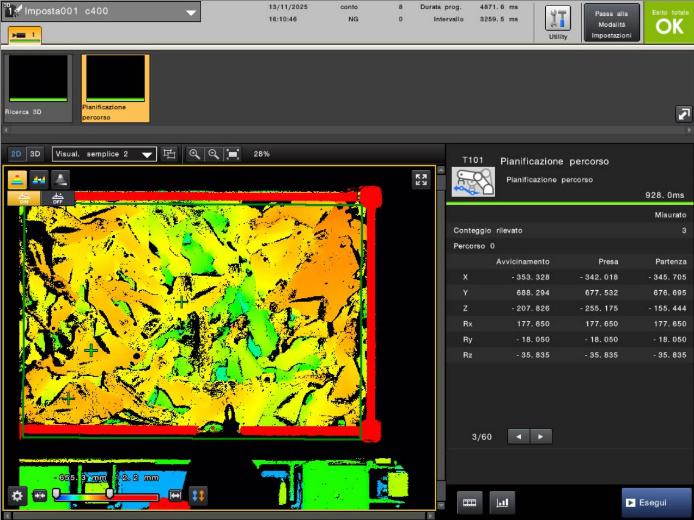
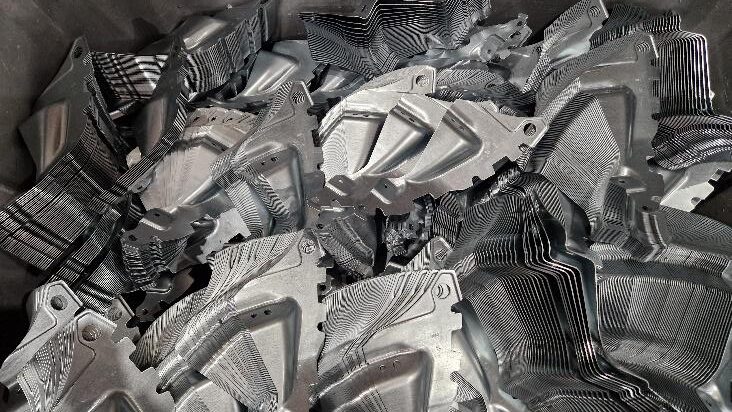
Choosing the best vision system is the most important aspect of the project: its purpose, in fact, is to detect the item being processed inside a bin (in which the pieces are arranged randomly), and communicate with the other modules in the system to enable them to be retrieved.. Therefore, a “3D robot guidance” system was chosen, which—thanks to artificial intelligence—allows the 3D images captured by the cameras to be compared in real time with the parts’ geometric models, thereby “guiding” the robot during the picking phase. Thanks to its streamlined logic, this solution ensures maximum reliability and precision, all with unmatched speed.
analyze the random arrangement of components in the container in real time
determine its position and orientation
provide the robot with precise data for bin picking
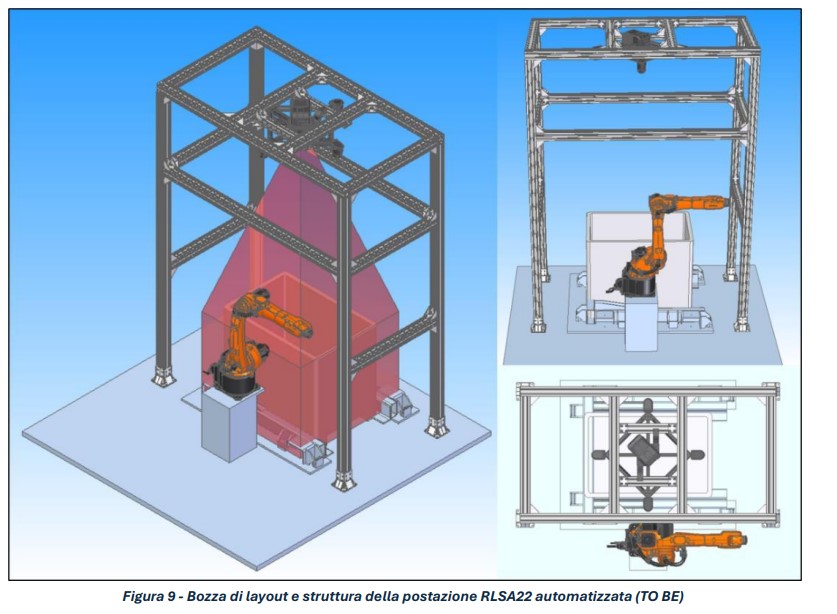
The system under development
THE SWINGING PLATFORM
Dynamic support to optimize the picking process
The development team came up with another solution to the problem of the random arrangement of the pieces in the container: the creation of a dedicated oscillating platform, which is pneumatically operated and capable of lifting, tilting, and shaking the bin to facilitate the removal of parts even when they are stored in awkward positions or at the bottom (due to uneven or partial filling).
This technology, integrated with algorithms for Artificial Intelligence, is designed for simplify the operation of the 3D vision system and optimize the robot's part picking. The goal is to maximize system uptime by minimizing unplanned downtime and ensuring maximum repeatability in the picking process.
PICK AND PLACE: SYNONYMOUS WITH SPEED AND PRECISION
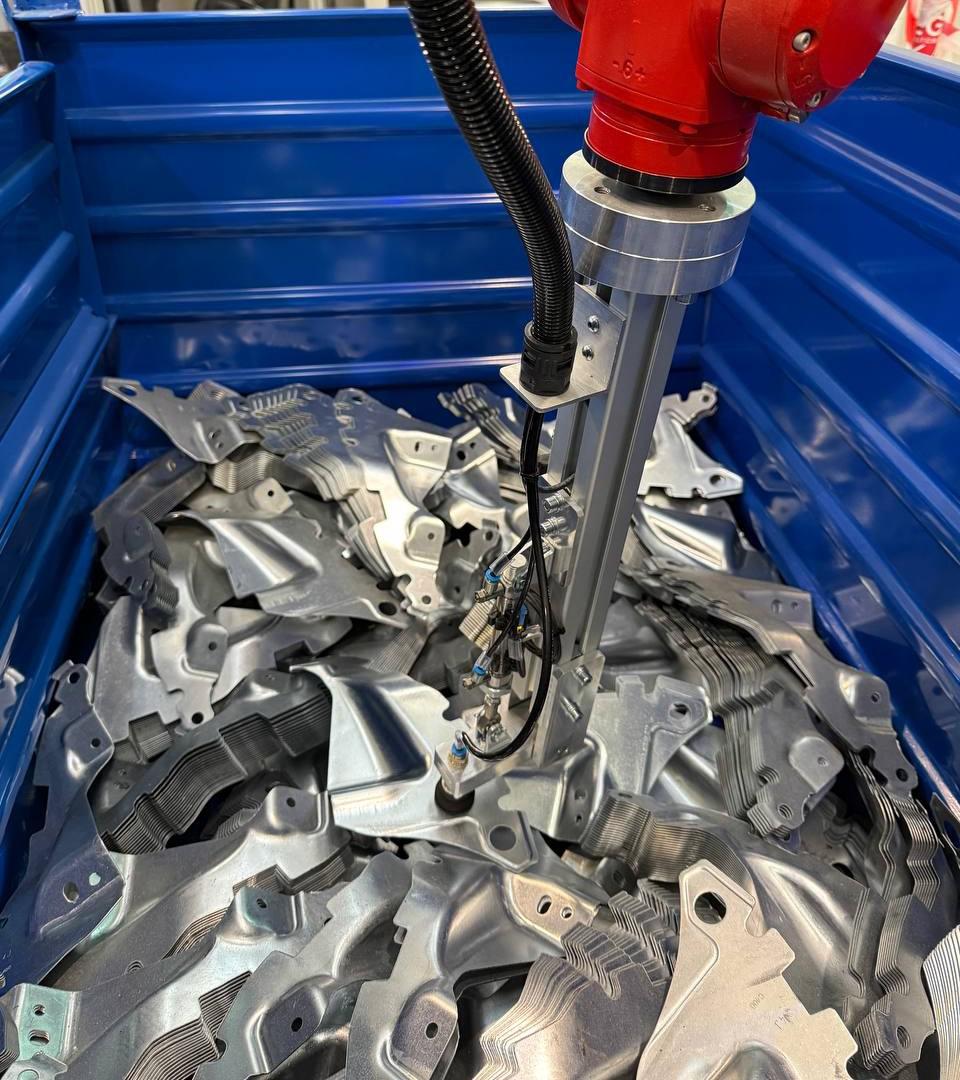
Robotic picking and perfectly repeatable placement
The latest module developed as part of the project is the pick-and-place system—that is, all the devices that, guided by the vision system, pick up and place parts in their designated locations. The goal of ensuring maximum speed and the highest possible precision—while minimizing the welding machine’s wait times—led the development team to choose a 7-axis anthropomorphic robot, controlled by the system’s PLC and guided by the 3D vision system.
The gripper, on the other hand, is designed and sized according to the structural constraints of the welding machine and is equipped with an RFID recognition mechanism to ensure proper association with the work program. The picking mechanism, selected with a view to maximum interchangeability and operating conditions, is a vacuum-based system with a suction cup—a proven and extremely effective solution for this application.
EXPECTED RESULTS
Efficiency, Precision, and Automation
Once completed and installed at the plant, the solution will make it possible to achieve
Reduction in Manual Work
Greater operational continuity
Consistent quality in the positioning of parts
Increase in plant productivity
Optimizing the flow to the welding equipment
Become ours Partner
Get in touch with us to find out more.